Gabor Granger pricing questions remain one of the most widely applied tools in global quantitative research because they can predict price sensitivity with clarity and speed. Brands use the method to identify willingness to pay, revenue-maximizing price levels, and demand curves across categories and markets. Although the technique appears simple, the precision of its question design determines how reliable the final pricing model becomes.
This article explains how Gabor Granger pricing questions work, why they remain a global standard for price testing, and how they uncover real willingness to pay. It also covers the method’s structure, its advantages and limitations, its comparison with Van Westendorp, and how researchers analyze the resulting demand curves.
What Are Gabor Granger Pricing Questions?
Gabor Granger pricing questions represent a quantitative approach used to determine how much consumers are willing to pay for a specific product or service. The method revolves around a sequence of direct purchase-intent inquiries at different price points.
As respondents move from one price to the next, their answers reveal demand elasticity and, ultimately, the highest price that still maintains interest.
This approach has remained relevant worldwide because it captures behavioral purchase decisions rather than abstract perceptions. It differs from broader forms of consumer research by focusing on a specific action and a measurable willingness to buy.
Researchers use it in innovation studies, product development programs, brand strategy, and revenue optimization work. Many organizations depend on foundational research guides, such as quantitative methods, which reinforces why structured models outperform guesswork in price strategy.
Resources such as the firm’s overview of market research methods provide helpful context for understanding where the Gabor-Granger model fits within the wider landscape of pricing research.
Across global markets, researchers turn to this method when they need answers quickly. It works as efficiently in early-stage concept tests as it does in established categories where brands want to justify premium positioning or validate discount thresholds. Its direct nature produces a demand curve that can be modeled across consumer groups, regions, or product tiers.
How Gabor Granger Pricing Works: From Question Design to Demand Modeling
Gabor Granger pricing follows a sequential logic that makes it distinct from other price sensitivity tools. A respondent sees an initial price and indicates whether they would buy at that level. If they answer yes, the price increases. If they decline, the price decreases, or the sequence ends. The progression identifies a price point that reflects the upper limit of the respondent’s willingness to pay.
Because each answer triggers the next question, poor price-point selection can distort the resulting demand curve. Researchers, therefore, define the full price range in advance, considering factors such as category norms, competitive benchmarks, and cost structures.
What differentiates an average study from a strong one lies in how the question is worded. Respondents must understand what they are evaluating without feeling pushed toward a particular answer.
Some countries require firmer wording to prompt clarity, while others require softer phrasing to avoid perceived pressure. Purchase intent questions must remain consistent across price levels to avoid bias.

The Exact Wording of Effective Gabor Granger Pricing Questions
The heart of the method is the question itself. An effective Gabor Granger pricing question must ask directly whether the consumer would buy the product at a specific price. A standard example looks like this: “Would you purchase this product for 25 dollars?” If the respondent says yes, the next higher price appears. If they say no, the next lower price appears, or the sequence closes.
The challenge arises when this simple structure must adapt to cultural standards. In some Asian markets, respondents often avoid direct refusal, which can inflate willingness to pay if the wording is too absolute. European respondents tend to answer more realistically when asked about actual purchase likelihood rather than intention alone. North American respondents may respond more predictably to a clean, clear question because direct communication styles fit local expectations. The consistency of wording across prices is essential; any change in tone can affect the resulting model.
For digital products, subscription models, and global services, researchers often tailor the language to clarify billing cycles, platform access, or renewal terms. This nuance increases realism and produces more accurate demand curves.
How Many Price Points to Test and Why Sample Structure Matters
Selecting the appropriate number of price levels is a balancing act between statistical accuracy and respondent fatigue. Researchers who want a smooth demand curve typically use 5 to 7 price points. A narrow range misses the true inflection point, while a range that is too wide can create unrealistic scenarios that distort data.
Sample size also plays a direct role in modeling power. A global study usually needs larger sample groups because cultural variation affects willingness to pay. Consumer goods often require broader samples than specialized technology products because price sensitivity differs across socioeconomic groups. The following table illustrates how sample size and number of price points affect reliability in a typical Gabor Granger pricing study.
| Variable | Low Sample / Few Prices | High Sample / Multiple Prices |
| Demand Curve Smoothness | Often inconsistent | Generally stable |
| Pricing Precision | Limited | Strong |
| Revenue Forecast Accuracy | Moderate | High |
| Cultural Insights | Weak | Strong |
Gabor Granger Analysis: How Data Translates Into Optimal Pricing
Once responses are collected, researchers convert them into a demand curve. This curve shows the proportion of consumers willing to buy at each tested price. As the price rises, demand typically falls. The point where revenue peaks usually becomes the recommended price. Analysts examine elasticity, inflection points, and category norms to calculate the optimal level.
Gabor Granger analysis often reveals more than just a single recommended price. It shows how sensitive consumers are to small price adjustments. If demand drops sharply when the price increases slightly, the product sits in a highly elastic market. If demand declines slowly, the product can likely support a premium. When these insights combine with behavioral measures, such as those described in MainBrain’s technology and methodology, the model becomes stronger because it incorporates subconscious drivers rather than conscious rationalization alone.
Some organizations treat Gabor Granger as a standalone method, but experienced researchers know that advanced interpretation requires triangulation. When integrated with qualitative work, brand perception studies, or advanced pricing models, the results become far more robust.
Gabor Granger vs Van Westendorp: When Each Method Wins
The ongoing comparison between Gabor Granger and Van Westendorp remains a central discussion in pricing research. Van Westendorp pricing identifies 4 psychological thresholds: too cheap, bargain, expensive, and too expensive. It focuses on perception rather than purchase action. Gabor Granger, in contrast, measures direct behavioral intent.
Van Westendorp excels in early-stage projects where brands want to understand perceived value boundaries before determining purchase intent. It is widely used for new categories, luxury positioning, and concept refinement. Gabor Granger performs best when the goal is to build a revenue model or determine the exact price that maximizes profit.
The next table summarizes their differences.
| Dimension | Gabor Granger | Van Westendorp |
| Measures | Behavioral purchase interest | Perceived price thresholds |
| Output | Demand curve, optimal price | Price range and perception boundaries |
| Best For | Revenue forecasting, price optimization | Early concept shaping |
| Weakness | May overstate WTP | May understate real purchasing behavior |
Researchers often use both methods together. Van Westendorp sets perceptual guardrails, and Gabor Granger identifies the price where revenue peaks. This combination gives global brands a more realistic pricing framework.
Limitations and Misuses of the Gabor Granger Pricing Method
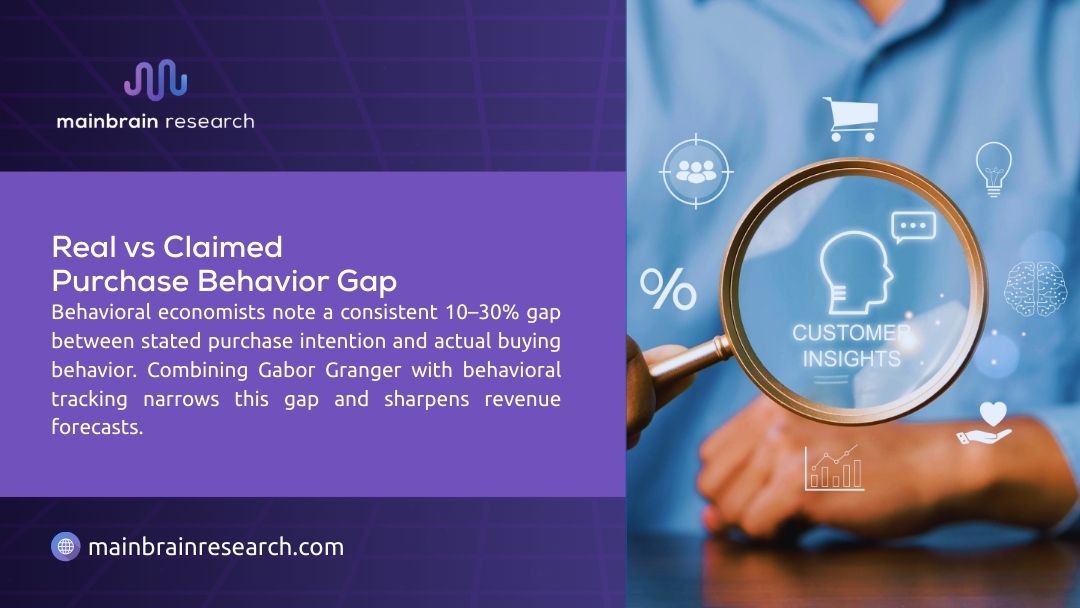
No pricing model works flawlessly, and Gabor Granger is no exception. Respondents often overestimate their willingness to buy because the survey environment lacks real-world financial consequences. That tendency can inflate optimal prices if the questions are not calibrated carefully.
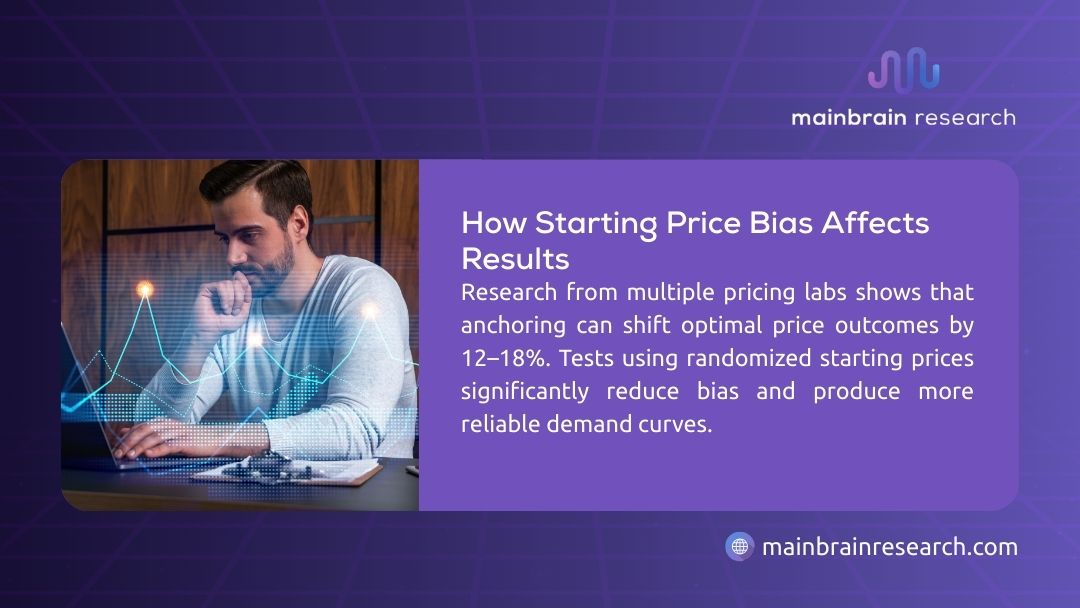
Sequential question design can also create anchoring bias. If the starting price is too low, respondents may appear more price-sensitive than they truly are. If the starting price is too high, many respondents may refuse immediately, producing a compressed demand curve. Cross-market distortions arise when cultural norms affect how people respond to direct purchase questions.
Another common misuse appears when companies adopt the method without a strong market research structure. Foundational references of why market research matters show that no pricing study functions well without correct sampling, framing, and context. Without those, even a precisely designed question can fail.
Alternatives to Gabor Granger: Conjoint, MaxDiff, and Behavioral Models
Conjoint analysis and MaxDiff analysis provide richer, multi-attribute pricing insights when products have layered features or complex competitive landscapes. Conjoint analysis models real-world purchase trade-offs by combining attributes, prices, and differentiators. MaxDiff identifies which product attributes matter most and supports pricing indirectly by clarifying value priorities. These methods often outperform Gabor Granger when product features significantly influence willingness to pay.
Behavioral pricing models, including neuroscience-based approaches, also provide strong alternatives. Eye tracking and EEG measurements uncover subconscious responses to pricing cues, framing effects, and value signals. When combined with traditional models, these approaches reveal far deeper truths about price acceptance.
How Market Research Companies Run Gabor Granger More Accurately Than DIY Tools
Professional market research agencies enhance accuracy by applying cross-method triangulation, advanced modeling, and behavioral insights. They refine question design, test multiple starting prices, and validate responses through consistency checks. Their approach integrates technology, statistical safeguards, and consumer psychology.
MainBrain Research, for example, applies neuroscience and predictive analytics to strengthen traditional price testing. Its innovation lab methods and strategic solutions help companies avoid common errors that distort willingness-to-pay estimates. Agencies also incorporate broader insights from category dynamics, competitive positioning, and brand perception that DIY tools fail to capture.
Conclusion: Why Strong Gabor Granger Pricing Questions Shape Global Pricing Decisions
Gabor Granger’s pricing questions continue to influence global pricing strategy because they reveal how consumers behave when price becomes the deciding factor. The method supports revenue modeling, product development, portfolio planning, and long-term strategic decisions where price sensitivity determines commercial success. Its value hinges on the precision of the question design, the relevance of the tested price range, and the discipline applied during analysis.
Organizations that want dependable pricing insight benefit most when they combine strong question construction, culturally appropriate phrasing, thoughtful sampling, and advanced modeling. As markets evolve, consumers evaluate price differently across regions, categories, and economic cycles, making structured pricing research more important than ever.
Companies seeking deeper accuracy can turn to specialized partners who understand both the behavioral and analytical sides of pricing. Businesses looking to integrate Gabor Granger into broader research initiatives can explore advanced methodologies through MainBrain Research’s page on technology and research frameworks.
Those ready to put structured pricing tools into practice can connect directly with expert consultants through the firm’s contact center and begin shaping a pricing strategy supported by evidence, not assumption.