This article examines the impact of eye tracking market research on helping organizations gain a deeper understanding of the concepts of attention, perception, and decision-making. Given the technical support and growth of the global market and the significance of tracking attention, eye tracking research is a way to understand how people visually interact with content, products, and settings in a variety of fields.
What is Eye Tracking and How Does it Work
Eye tracking is a method of research that involves the recording of a person’s eye movements to establish where they are looking, how long they are concentrating, and how their gaze wanders to and from.
In eye tracking market research, technology can capture subconscious behavior that mechanized responses are incapable of detecting. Eye tracking is far more than observational research, providing more quantifiable measures of attention, interest, and processing.
Eye tracking technology makes use of a camera and infrared light to observe the position of the pupils and the light reflections from their eyes. These signals are converted into eye tracking data, which the researcher uses to determine the visual hierarchy for that data.
Each of the types of eye tracking technology serves a purpose that is determined by the objectives of the research, the environment, and the precision of the technology.
| Eye Tracking Type | Description | Common Use |
| Remote eye tracking | Screen-based tracking using fixed cameras | UX testing, advertising studies |
| Wearable eye tracking | Glasses-mounted systems for real environments | Retail and in-store research |
| Webcam eye tracking software | Software-based gaze estimation via webcams | Scalable online studies |
| Mobile eye tracking | Lightweight devices for field research | Shopper behavior analysis |
How Eye Tracking Works
Calibration is the start of every eye tracking research, and is when the system is being trained to understand the unique eye behavior of the subjects to different visual stimuli. The rest of the process involves tracking gaze direction and movement, for which the system has to be calibrated, to monitor how the participants are interacting with the content.
The system records this information in the form of fixations, scan paths, or attention distribution over different areas of the screen, which helps the researcher understand how certain visuals in the content affect the perception of the participants and the choices they make. This process is of great significance as the use of memory and self-reporting in determining how visuals affect perception is often flawed.
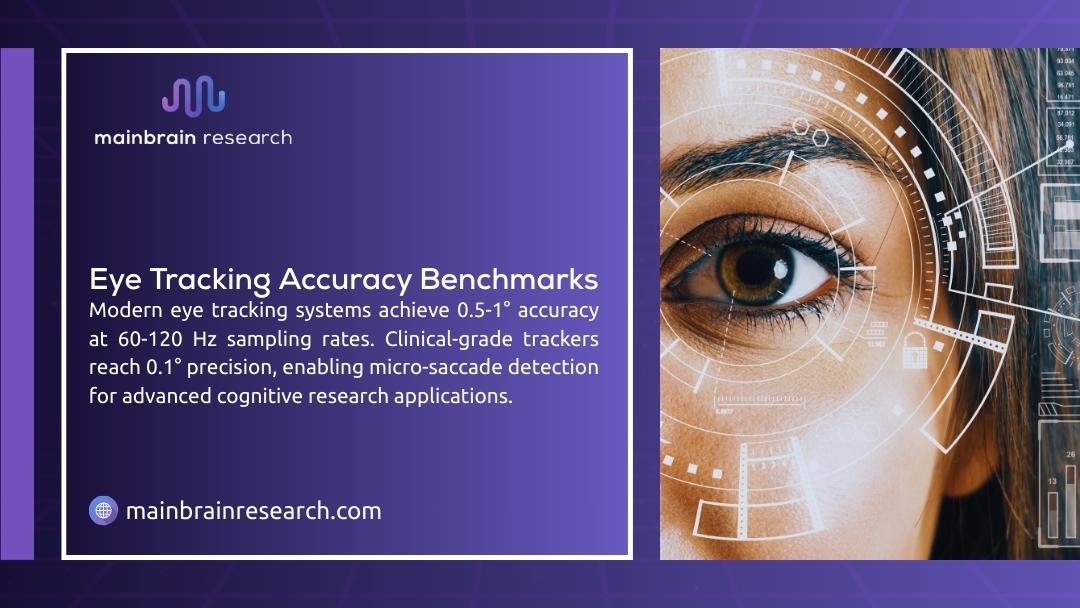
Global Eye Tracking Market Growth and Economic Scale
In the last few years, the eye tracking market has been experiencing rapid dispersion worldwide as different companies, analytics, and marketing systems are prioritizing the incorporation of accurate behavior profiling systems.
The eye tracking market is predicted to continue to grow from being used mainly in academic niches to being used in various commercial systems. This is primarily due to the advancements in the systems and the growing demand for attention analytics in product design and marketing.
| Market Indicator | Global Estimate |
| Market size (2025) | USD 2.4 billion |
| Projected size (2035) | USD 25 billion |
| Estimated CAGR | Over 26% |
North America and Europe are leading adoption, while the Asia Pacific is experiencing rapid growth due to digital trade and UX-focused sectors. The growth of webcam eye-tracking software has further democratized access to eye-tracking market research for organizations of all scales.
How Eye Tracking Improves the Quality of Market Research
Research Quality is enhanced by eye tracking market research because it is able to accurately record what the market responds to visually, as opposed to what they claim to take notice of.
Market research has always been reliant on traditional systems such as recalls and interpretative work, which can often be biased and even rationalized. Eye Tracking research captures attentional deflection in real-time to retain the quality of the research and work on it harmoniously.
With pinpointed eye tracking analytics, it becomes evident as to which visuals capture and retain attention, or are simply glanced over, and how a sequence of visuals can build, or take away comprehension of the content.
With the assistance of quantitative market research, the uncertainty of a decision is further reduced, and the eye tracking data strengthens the reliability of the inquired insight. Consequently, it empowers the researchers to defend their hypotheses with evidence of behavior, as opposed to making analytical assumptions.
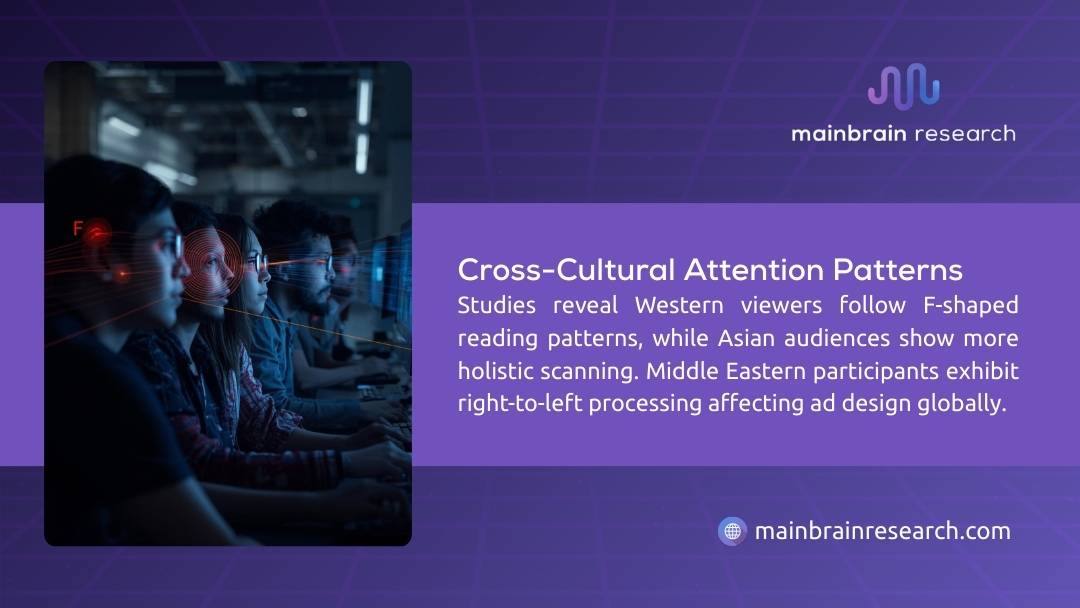
Uses of Eye Tracking in Marketing, Advertising, and Consumer Research
Eye-tracking marketing studies have been used to assess advertising effectiveness, product packaging, and digital experiences. Prior to the table below, it is essential to mention that eye-tracking studies are not meant to replace traditional research, but rather supplement it by uncovering behavioral patterns that traditional surveys miss.
| Application Area | Research Purpose |
| Eye tracking advertising | Measure attention to ads and brand elements |
| Retail and shopper research | Analyze shelf visibility and navigation |
| UX and web design | Identify usability barriers and visual flow |
| Product testing | Evaluate packaging and label engagement |
Organizations often refine creative assets, adjust layouts, and enhance their conversion results based on the insights eye tracking advertising has to offer. This technique has particular value in testing eye-tracking ads in highly competitive, attention-limited, digital environments.
Technological Applications, Tools, and Software in Eye Tracking Research
Eye-tracking tools capture precise hardware and thoughtful software integration. The selection of tools is based on the characteristics of the study in terms of its scale, environment, and accuracy requirements.
| Technology Component | Function |
| Eye tracking software | Converts gaze data into visual insights |
| Remote eye trackers | Capture screen-based attention |
| Wearable eye trackers | Record real-world visual behavior |
| Eye tracking analytics platforms | Analyze and visualize eye tracking data |
Once data is collected, these platforms are used by researchers to identify behavioral patterns and integrate the findings into larger research studies. The scalability and accuracy of this technology continue to improve.
Pros and Cons of Using Eye Tracking in Market Research
It is important to recognize that eye tracking market research offers unique strengths but also practical limitations.
| Advantages | Disadvantages |
| Captures subconscious attention | Requires calibration accuracy |
| Reduces self-report bias | Higher cost than basic surveys |
| Provides objective visual data | Interpretation requires expertise |
| Enhances marketing and UX insights | Environmental sensitivity |
After considering these factors, many organizations opt to pair eye tracking testing with other research techniques to enhance the depth of insights.
Global Future of Eye Tracking Market Research
Improved accessibility and more advanced analytics are on the horizon for eye-tracking market research. There are many recent advancements in eye-tracking technology. These include mobile-compatible systems, AI gaze prediction, and active behavioral model tracking. Such technology is designed to use eye-tracking outside of controlled environments. There will be greater use of eye-tracking in everyday digital and physical spaces.
As eye tracking neuromarketing gains traction, businesses leverage eye tracking studies for understanding emotional engagement and cognitive load. With eye tracking analytics integrated into big data systems, we can predict a future where attention analytics become core to data-driven decision making.

Why Eye Tracking Market Research is Important for Driving Strategic Decisions
Eye tracking market research grants organizations unparalleled access to understanding the information processing of individuals at a visual level. It captures actively engaged attention, enabling more intelligent decisions to be made in marketing, product design, and customer experience management.
The increasing prevalence of competitors in the market and the congestion of valuable customer attention present a challenge and a threat to organizations still relying on guesswork.
Eye tracking research empowers leaders to be actionable on evidence-based insights. Organizations interested in advanced eye tracking market research and its application in a solid research design can access expert solutions and services offered by MainBrain Research, where behavioral sciences, technology, and strategic thinking interplay for actionable insights.