Mobile ethnography research has reshaped how qualitative research captures behavior, context, and decision-making. By using mobile devices to document lived experiences as they occur, this research approach provides access to consumer realities that structured environments cannot replicate.
This article examines how mobile ethnography works, where it fits within modern research methods, and why it has become essential for global qualitative market research.
Understanding Mobile Ethnography Research
Mobile ethnography research is a qualitative research method rooted in traditional ethnographic research, adapted for a mobile-first world. Participants document experiences through a mobile ethnography app while they go about their daily routines. Photos, short videos, voice notes, and written reflections form the core data, collected within the participant’s natural environment rather than a controlled research setting.
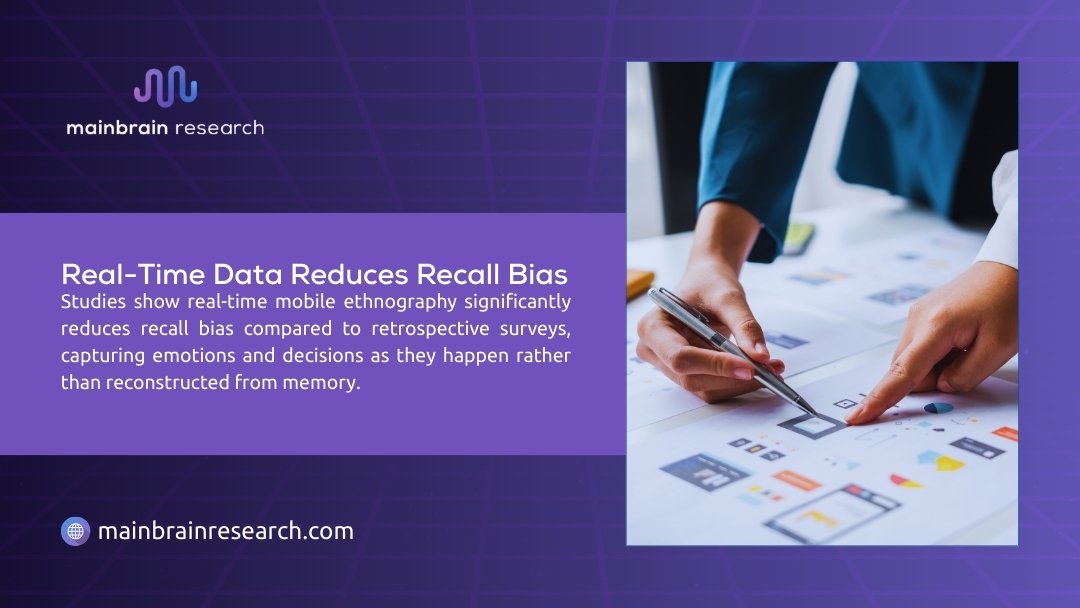
What distinguishes mobile ethnography from other ethnography tools is timing. Data appears at the moment behavior occurs, not hours or days later. This real-time capture allows researchers to observe actions and emotions without the distortions of memory or social pressure. In this sense, mobile ethnography research acts as both observer and recorder, embedded directly into everyday life.
Mobile Ethnography Compared to Other Research Methods
| Research Method | Data Timing | Natural Setting | Context Accuracy | Scale |
| Traditional ethnographic research | Delayed | Yes | High | Limited |
| Mobile ethnography research | Real time | Yes | Very high | High |
| Focus group research | Post-session | No | Medium | Medium |
| Survey research | Retrospective | Variable | Low | High |
Why Ethnography Moved to Mobile
Ethnographic research once required physical presence, limited samples, and long timelines. As mobile devices became universal, researchers recognized that observation no longer needed to be physical to remain authentic. Mobile ethnography emerged as a practical response to these constraints, offering scale without sacrificing depth.
The purpose of mobile ethnography research is not efficiency alone. It exists to reveal how people interact with products, services, and brands when no moderator is watching. Traditional focus group settings often influence behavior through social cues. Mobile ethnography removes that layer, allowing researchers to see how decisions form naturally.
Ethnographic market research draws from anthropological traditions that focus on observing people in their natural environments to understand real behaviors, motivations, and decision-making patterns. A clear explanation of how ethnographic market research is applied in practice helps connect these foundational methods to modern business and healthcare research contexts.
How a Mobile Ethnography Study Is Conducted
A mobile ethnography study begins with clearly defined research objectives aligned with broader qualitative research methods. Participants receive structured prompts through a mobile ethnography app, often spread across several days or weeks. These prompts resemble a diary study, but with multimedia input and immediate submission.
Because participants use their own mobile device, engagement feels natural rather than intrusive. Researchers monitor submissions in real time, allowing follow-up questions that respond to emerging behavior. This adaptive design distinguishes mobile ethnography research from static qualitative research approaches.
Effective research depends on a structured approach to planning, data collection, and analysis, all of which shape the quality of the insights that follow. A practical look at how to do market research helps clarify how those steps fit together in real-world projects.
Technology Behind Mobile Ethnography Tools
Mobile ethnography tools combine participant-facing simplicity with researcher-facing analytical depth. Platforms typically support image capture, video uploads, location data, and open-ended responses. On the analysis side, researchers review content within dashboards that organize material by theme, timing, and context.
Unlike traditional ethnography tools, mobile platforms allow researchers to conduct studies across multiple markets simultaneously. This scalability has made mobile ethnography research especially valuable in global qualitative market research.
Complementary approaches to understanding customer behavior and decision-making are often discussed alongside qualitative work, and a practical breakdown of market research methods helps place ethnographic insights within the broader research toolkit.
Strengths and Limitations of Mobile Ethnography Research
Mobile ethnography research offers distinct advantages by capturing behavior as it naturally occurs, providing depth that structured research environments often fail to deliver.
Strengths of Mobile Ethnography Research
| Dimension | Strength |
| Authentic behavior | Records actions and reactions within real-life settings rather than simulated research environments |
| Contextual insight | Captures emotional, environmental, and situational factors alongside behavior |
| Participant comfort | Relies on personal mobile devices, reducing disruption and increasing natural engagement |
| Research depth | Supports longitudinal observation through diary-based and real-time submissions |
| Data richness | Combines visual, audio, and written inputs for multidimensional qualitative insight |
| Strategic value | Reveals gaps between stated intent and actual behavior |
While the method provides powerful insight, it also presents limitations that require careful planning and ethical consideration to ensure research quality and integrity.
Limitations of Mobile Ethnography Research
| Dimension | Limitation |
| Participant engagement | Variations in motivation can affect consistency and data completeness |
| Data management | Large volumes of unstructured content demand time-intensive analysis |
| Interpretation bias | Insights rely heavily on the researcher’s judgment and contextual understanding |
| Study design | Poor task structure may lead to participant fatigue or unclear responses |
| Privacy concerns | Personal environments introduce higher ethical and data protection risks |
| Resource demands | Skilled moderation and analysis increase operational complexity |
When these limitations are acknowledged and managed effectively, mobile ethnography research remains a highly reliable qualitative research method for understanding real-world behavior.
Where Mobile Ethnography Research Delivers Value
Mobile ethnography research creates value by revealing how people actually behave in everyday situations, allowing researchers to observe decisions, emotions, and habits as they unfold rather than relying on post-event explanation. This real-time perspective is particularly valuable in contexts where experience, environment, and emotion shape outcomes.
| Application Area | Value Delivered by Mobile Ethnography Research |
| Product usage | Reveals how products are used in daily life, including workarounds and unmet needs |
| Retail behavior | Captures in-store decision-making and shopper reactions within natural settings |
| Healthcare experiences | Documents patient journeys, emotional responses, and treatment routines |
| Digital services | Observes real interaction patterns across apps, platforms, and devices |
| Brand engagement | Identifies emotional triggers and moments of connection across touchpoints |
| Service evaluation | Highlights friction points during real customer interactions |
When combined with primary and secondary research programs, mobile ethnography research strengthens interpretation by connecting observed behavior with stated motivation, creating a more complete and reliable foundation for strategic decision-making.
Selecting Mobile Ethnography Platforms and Apps
Choosing the right mobile ethnography platform depends on study objectives rather than feature volume. Some platforms emphasize rapid submissions and short-term observation, while others support long-form mobile ethnographic studies that track behavioral change over time.
The most effective mobile ethnography app balances participant ease with researcher control. Flexibility in task design, real-time monitoring, and secure data handling remain critical factors. When aligned correctly, mobile ethnography platforms enhance research quality rather than constrain it.
Common Mobile Ethnography Research Scenarios
| Research Scenario | Study Structure | Insight Gained |
| Daily product usage | Mobile diary study | Habitual behavior |
| Emotional reactions | Multimedia entries | Contextual emotion |
| Cultural comparison | Cross-market study | Behavioral variation |
Integrating Mobile Ethnography with Other Research Approaches
Mobile ethnography research rarely replaces other qualitative research methods. Instead, it informs them. Insights from mobile studies often shape survey design, guide interview questions, or clarify patterns seen in quantitative data.
Understanding how mobile ethnography fits within a broader research framework helps organizations maximize its value. Market research is commonly grouped into several broad categories based on purpose and methodology, and understanding how these approaches differ helps teams choose the right method for each question. A practical breakdown of the types of market research shows how qualitative and quantitative approaches are typically applied in real-world studies.
Why Mobile Ethnography Research Changes Strategic Decisions
Mobile ethnography research shifts strategic thinking by grounding decisions in observed behavior rather than stated intention. What people say they do and what they actually do often diverge, and these gaps reveal unmet needs, hidden friction, and unspoken motivations. By capturing behavior as it unfolds, this research method replaces assumptions with evidence.
As qualitative research continues to evolve, mobile ethnography stands apart for its ability to document reality without shaping it. It preserves context, emotion, and environment while removing the influence of artificial settings. In doing so, mobile ethnography research converts lived experience into credible insight, enabling strategies that reflect how people truly think, act, and decide.
Conclusion: A Research Approach Grounded in Real Life
Mobile ethnography research captures life as it is lived, not as it is later recalled. By observing behavior within its natural context, it removes the distortion created by artificial research settings and surfaces insights rooted in reality rather than assumptions. This ability to document experience without interference gives organizations a clearer understanding of how decisions truly form.
For teams seeking research that informs strategy with evidence drawn from real-world behavior, partnering with specialists who design and interpret mobile ethnographic studies with rigor becomes essential. Organizations ready to move beyond surface-level insight can explore strategic research solutions grounded in behavioral evidence to turn observation into confident, actionable decisions.